Chapter 24
Who Needs to Approve the SSP, and How Do We Record That Approval?
Your plan is written, but no one has signed it yet. An unsigned plan reads like a draft, no matter how good the text is. An assessor will ask who stands behind it, and you need a clear answer.
The assessor does not approve your plan
Start with a common mix up. A C3PAO does not approve your SSP. C3PAO means Certified Third-Party Assessment Organization. It assesses your plan against CMMC practices. CMMC means Cybersecurity Maturity Model Certification.
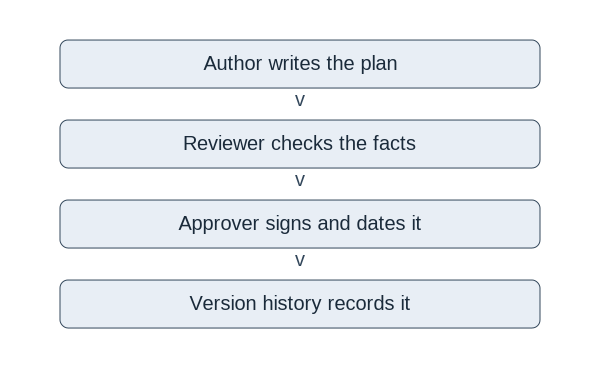
Approval comes from inside your company. The plan needs a senior person who owns the system and its risk. That person is usually the system owner, or a senior leader above that owner. A junior author cannot approve their own work. Separation between author and approver is the point.
NIST SP 800-171 Revision 2 requires the SSP itself. NIST means National Institute of Standards and Technology. Requirement 3.12.4 requires plans that describe boundaries, environments, and connections (NIST SP 800-171 Revision 2). Each plan states how each requirement is met. The guide requires the plan, and good practice requires a named approver behind it.
Who should sign
Pick one approver, not a committee. The approver should have authority over the system budget and its risk choices. That is often the company owner in a small firm. In a larger firm, it may be a vice president or a chief officer.
Name a second person as reviewer, separate from the approver. The reviewer checks facts, dates, and control details before approval. The approver then signs based on that review, not on trust alone.
Do not list the whole staff as approvers. A signature page with ten names proves nothing. One clear approver, with a title and a date, proves ownership.
What the approval record must show
Put an approval page at the front of the plan. That page lists the approver name, title, signature, and date. It lists the plan version being approved. It lists the reviewer name and date too.
Keep the signed page with the plan version it approves. A signature for version 1.0 does not approve version 2.0. Each major change needs a fresh approval, or a dated note that states what changed and who accepted it.
Record approval in the version history as well. Each version line should show the date, the author, the change made, and the approver. An assessor reads version history first, because it shows whether the plan is alive or stale.
How to handle changes after approval
Small fixes, such as typo corrections, do not need a new signature. Log them in the version history with a date and an author. Larger changes do need fresh approval. A new system boundary, a new cloud service, or a dropped control all count as larger changes.
Set a review date at approval time. Review the plan at least once a year, and after any major change. An approval with no review date will age quietly. A plan approved three years ago, with no review since, reads as a draft to an assessor.
Store the signed copy where it cannot be edited by accident. Keep an editable working copy separate from the signed record. If the signed copy can be changed without a trace, its value drops to zero.
Next step
PolicyCortex collects evidence from live Azure configuration using 33 collectors. The collectors read conditional access, diagnostic settings, Defender posture, backup, and firewall. The evidence is evaluated against NIST 800-53 and NIST 800-171. It supports re-verification after remediation. It generates SSP, SAR, and POA&M output from collected evidence. SAR means Security Assessment Report. POA&M means Plan of Action and Milestones. PolicyCortex is strongest in commercial Azure, and AWS is covered. Start at https://policycortex.com.
Sources
- NIST SP 800-171 Revision 2, Protecting Controlled Unclassified Information in Nonfederal Systems and Organizations, National Institute of Standards and Technology. https://doi.org/10.6028/NIST.SP.800-171r2
- NIST SP 800-171A Revision 2, Assessing Security Requirements for Controlled Unclassified Information, National Institute of Standards and Technology. https://nvlpubs.nist.gov/nistpubs/SpecialPublications/NIST.SP.800-171a.pdf
- 32 CFR Part 170, Cybersecurity Maturity Model Certification (CMMC) Program, U.S. Department of Defense, eCFR. https://www.ecfr.gov/current/title-32/subtitle-A/chapter-I/subchapter-G/part-170