Chapter 56
UpdraftCentral Means Updating the SSP Supply Chain Section
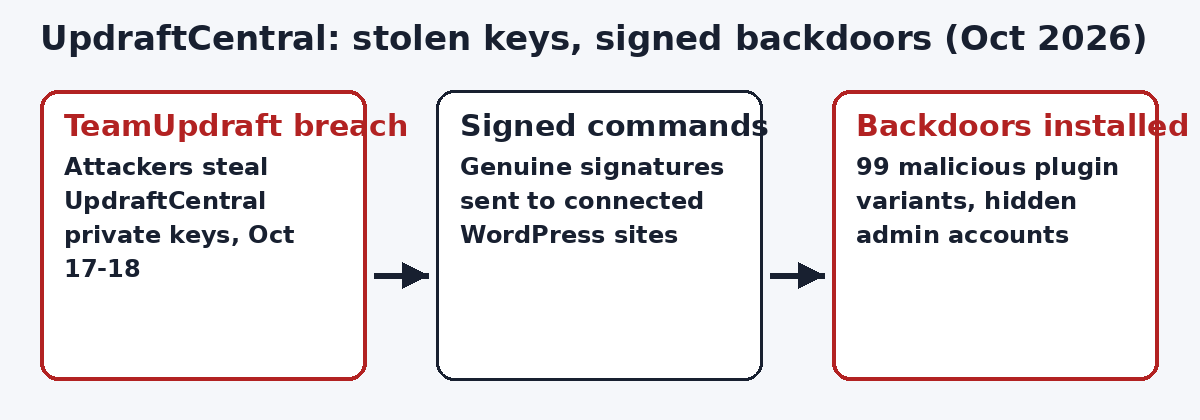
A System Security Plan (SSP) names the vendors your system depends on. After UpdraftCentral, that list should include every vendor that holds signing power over your systems.
Over the weekend of October 17 and 18, 2026, attackers broke into TeamUpdraft's website. They stole the private keys behind UpdraftCentral, the remote management service for UpdraftPlus. They sent commands to connected WordPress sites. The commands installed backdoor plugins with real signatures.
Security firm Nethemba found the campaign on its own servers. Security firm Patchstack counted 99 malicious plugin names installed between 15:32 UTC on October 18 and 09:23 UTC on October 19.
The SSP section to update
Most SSPs list software vendors and cloud providers. Fewer list the credentials and channels those vendors hold over the system. UpdraftCentral shows the channel is the risk, not just the software.
The SSP's supply chain section should name TeamUpdraft if you use its products. It should name the UpdraftCentral service specifically. It should record what the service can do to your systems and what the vendor did after the breach.
The POA&M entry
A Plan of Action and Milestones (POA&M) entry for this incident records the affected sites and keys. It records the update to UpdraftPlus 1.26.13 or Premium 2.26.13. It records the manual deletion of keys created between 12:07 and 21:00 UTC on October 18, 2026, which the update does not remove.
The entry closes when the compromise check is done: no unknown plugins, no unknown admin accounts, no unknown login cookies. The backdoor's hidden accounts can survive plugin removal, so the check must cover all three.
The lesson for the boundary
Vendor-held signing keys are part of your system boundary. The SSP should treat them as access paths, with owners, rotation schedules, and revocation procedures.
If the SSP cannot answer "who can sign commands into our systems," the incident will be the first time anyone asks. Ask it now.
What to do this week
Update the SSP's vendor and supply chain sections. Add the POA&M entry. Run the compromise check on every affected site.
Then set a review date for vendor-held access. Keys and channels change. The SSP should change with them.
Sources
- Security incident disclosure, TeamUpdraft, October 19, 2026. Vendor's primary incident statement.
- "Stolen UpdraftCentral Keys Are Backdooring WordPress Sites," Patchstack, October 19, 2026. https://patchstack.com/articles/updraftcentral-key-compromise-wordpress-backdoors/
- Campaign analysis, Nethemba, October 19, 2026. First detailed researcher analysis of the campaign.
- NIST SP 800-18 Revision 1, Guide for Developing Security Plans. https://doi.org/10.6028/NIST.SP.800-18r1
- Original diagram by PolicyCortex.
Next step
Want an SSP evidence base that reflects the live system? See how PolicyCortex collects it on Azure.