Chapter 55
PwnEscape Means Your SSP Must Name the Virtualization Layer
A System Security Plan (SSP) describes what you protect and where it runs. PwnEscape is a test of whether that description reaches the layer that enforces isolation.
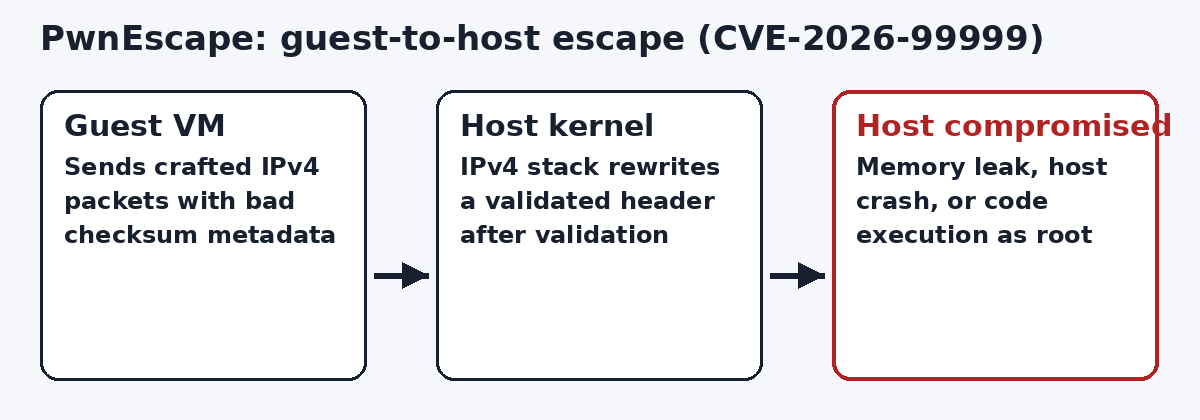
CVE-2026-99999 is a flaw in the Linux kernel's IPv4 stack. A guest virtual machine (VM) sends crafted packets with bad checksum metadata. The host kernel rewrites a validated header after validation. The guest reaches the host: memory leaks, crashes, and code execution as root. The Linux kernel security team rates it 9.3, Critical.
The flaw is in the host kernel, not the hypervisor. Patching guests does not fix it.
The boundary section
The SSP's system boundary section should name the virtualization layer. That means the hypervisor and the host kernel, with versions, with owners, and with the patch process.
Many SSPs describe workloads in detail and summarize the platform in a sentence. PwnEscape shows the platform sentence is where the risk lives. If the boundary section cannot answer "which host kernels run our VMs," it is incomplete.
The POA&M entry
A Plan of Action and Milestones (POA&M) entry for this flaw names the affected hosts. It records the current kernel version and the target fixed version. The fixed versions include 5.10.272, 5.15.223, 6.1.190, 6.6.159, 6.12.113, 6.18.57, and 7.2.11.
The entry records the patch date and the verification after. It closes when the scan shows the fixed kernel, not when the ticket is filed.
If a cloud provider owns the hosts, the SSP should reference the provider's patch evidence. Inherited controls still need a source.
The diagram test
Look at your SSP's system diagram. Find the hypervisor. Find the host kernel. If they are missing or drawn as one unlabeled box, update the diagram.
An assessor reads the diagram first. A diagram that hides the virtualization layer invites the question PwnEscape answers: who patches the layer that keeps tenants apart?
What to do this week
Patch the hosts, then update the documents. Add the host layer to the boundary section. Add the POA&M entry. Update the diagram.
Documents that trail the real system by a quarter are the norm. This flaw is a good reason to close the gap.
Sources
- CVE-2026-99999 record, CVE Program. Published October 15, 2026, updated October 19, 2026. CVSS 3.1 base score 9.3, Critical.
- PwnEscape technical writeup, pwn.ai. https://pwn.ai/blog/pwnescape
- NIST SP 800-18 Revision 1, Guide for Developing Security Plans. https://doi.org/10.6028/NIST.SP.800-18r1
- Original diagram by PolicyCortex.
Next step
Want an SSP evidence base that reflects the live system? See how PolicyCortex collects it on Azure.