Chapter 59
After Plex2Shell: Updating Your SSP and POA&M for a Chained Exploit
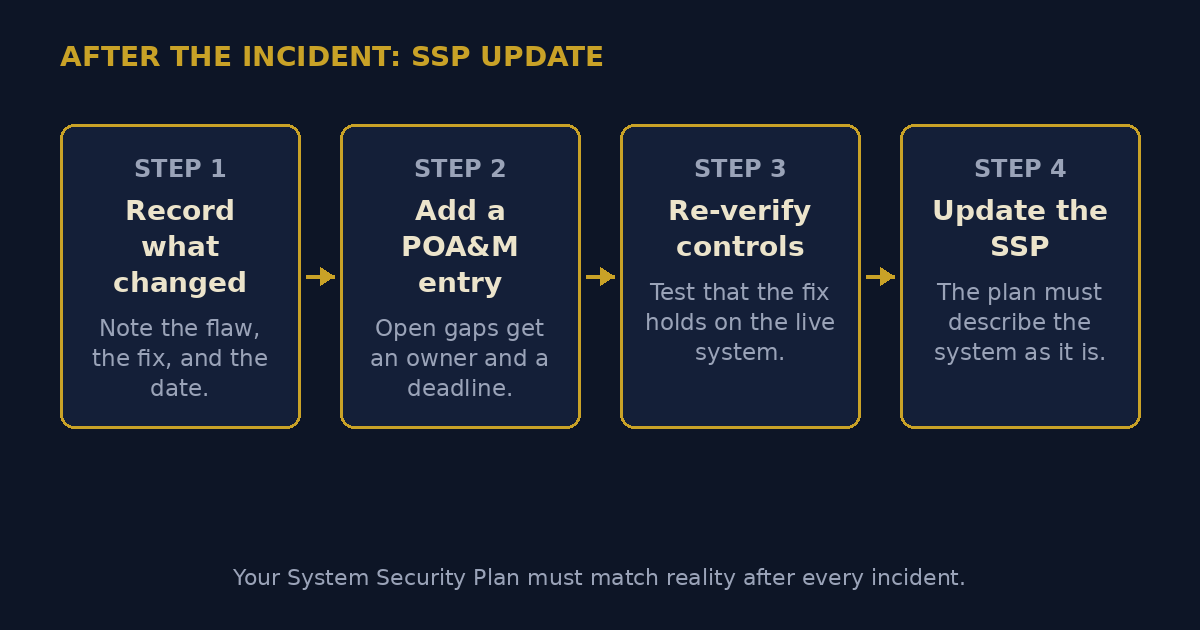
Your System Security Plan describes your system as it is. After Plex2Shell, for some teams, that description is out of date.
On October 20, 2026, CISA added four Plex Media Server flaws to its Known Exploited Vulnerabilities catalog. The flaws are CVE-2026-96652, CVE-2026-96654, CVE-2026-96655, and CVE-2026-96656. (CISA alert) Attackers chain them into code execution with no login. Fixed builds are 1.43.3.10861 and later.
If your network ran an exposed older build, the incident changed your system. The plan must catch up.
What the SSP must say now
SSP is System Security Plan. It documents how you meet each security requirement. POA&M is Plan of Action and Milestones. It lists open weaknesses with owners and deadlines.
First, update the inventory section. If a Plex Media Server existed in your environment and you removed or patched it, say so with the date. If it never existed, that negative is worth one line too.
Second, update the flaw remediation description. Practice SI.L2-3.14.1 asks for timely flaw correction. Describe how you learned of this one, how fast you moved, and what proof you kept.
The POA&M entries this incident creates
Every unpatched host is a POA&M entry until the fix is verified. The entry needs the CVE numbers, the affected systems, the owner, and the deadline. CISA gave federal agencies until October 23. Use a real date, not soon.
A possibly compromised host is a second entry. It stays open until the compromise check is done and the host is clean or rebuilt. A closed patch ticket does not close this entry.
Why a stale SSP hurts
An SSP that describes controls you do not have is a liability. At assessment time, the assessor compares the plan against the live system. A gap between the two reads as a misrepresentation.
The reverse is also true. A plan that records the incident, the fix, and the verification tells the assessor your process works. The incident becomes evidence of a working system, not a hidden failure.
What to do this week
Check whether any Plex Media Server ran in your environment below build 1.43.3.10861. Update the SSP inventory section with the finding and the date. Open POA&M entries for every unverified host.
Date every change. A plan with dates shows a system under control.
Sources
- CISA Adds Six Known Exploited Vulnerabilities to Catalog, CISA, October 20, 2026. https://www.cisa.gov/news-events/alerts/2026/10/20/cisa-adds-six-known-exploited-vulnerabilities-catalog
- CVE-2026-96656 record, CVE Program. https://www.cve.org/CVERecord?id=CVE-2026-96656
- NIST SP 800-171A, Assessing CUI Requirements. https://nvlpubs.nist.gov/nistpubs/SpecialPublications/NIST.SP.800-171Ar3.pdf
- Original diagram by PolicyCortex.
Next step
Want an SSP built from your live system instead of written from memory? See how PolicyCortex generates it on Azure.