Chapter 39
NGINX Flaws Mean an SSP Inventory and Config Update
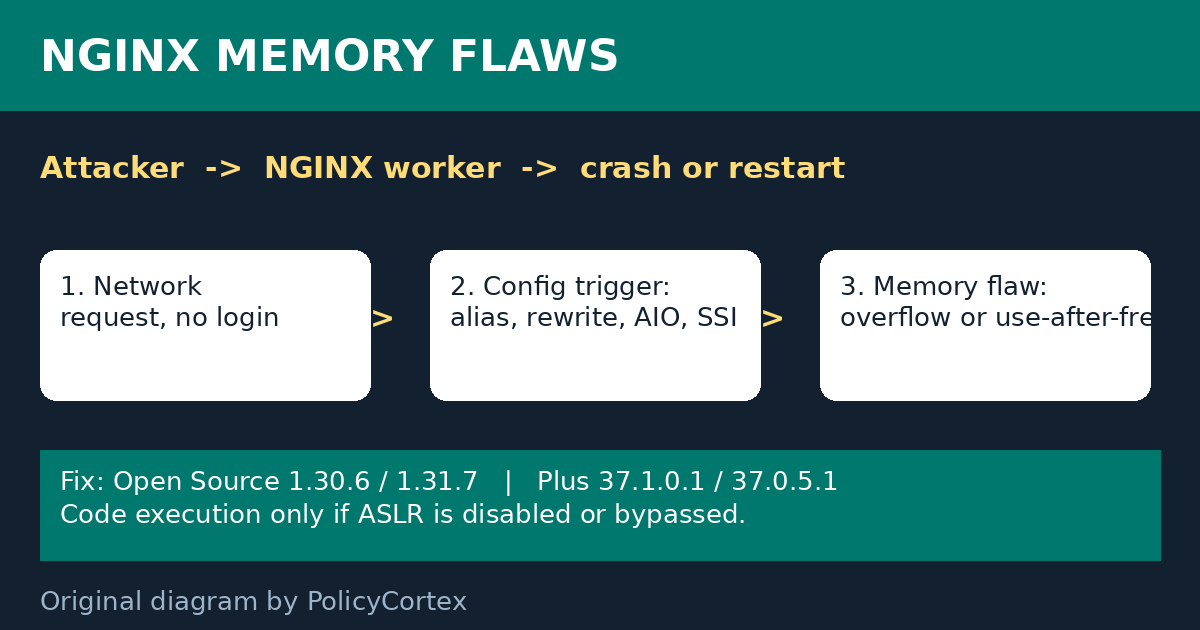
A system security plan describes the system you actually run. A patch notice is a prompt to check that description.
On October 14, 2026, F5 published out-of-band security notification K000163408. It fixes three NGINX memory flaws. F5 scores each flaw 9.2 under Common Vulnerability Scoring System (CVSS) version 4.0. NGINX itself rates them medium. Record both scores in the plan update. A future reader will wonder otherwise.
The three flaws
Common Vulnerabilities and Exposures (CVE) is the public record system. All three flaws are unauthenticated and network reachable. None needs user interaction. All three carry high attack complexity.
- CVE-2026-15176: heap buffer overflow in the core HTTP module, triggered by alias and rewrite directives using $request_filename.
- CVE-2026-97205: use-after-free flaw, needing asynchronous file input/output (AIO) with Server Side Includes (SSI) virtual includes.
- CVE-2026-93479: heap buffer overflow from premature regex map capture references and certain non-cacheable variable expressions.
The main impact is a worker process crash or restart. Code execution needs Address Space Layout Randomization (ASLR) disabled or bypassed. That limit belongs in the risk note for the plan.
Fixed builds are NGINX Open Source 1.30.6 and 1.31.7, and NGINX Plus 37.1.0.1 and 37.0.5.1.
Three SSP updates to make
First, check the system inventory lists every NGINX server. Add any it missed. Second, update the version recorded for each server after the upgrade. Third, update the config baseline where alias, rewrite, AIO, or SSI settings appear. Config triggers are part of the system description, not trivia.
No confirmed exploitation was reported through October 20, 2026. The Cybersecurity and Infrastructure Security Agency (CISA) Known Exploited Vulnerabilities (KEV) catalog does not list them. Update the plan now, while the patch is fresh. A stale plan fails a reader faster than a missing patch fails a scan.
Sources
- F5 security notification K000163408, NGINX Open Source and NGINX Plus vulnerabilities, October 14, 2026.
- CVE-2026-15176 record, CVE Program.
- CVE-2026-97205 record, CVE Program.
- CVE-2026-93479 record, CVE Program.
- Original diagram by PolicyCortex.
Next step
Want plan evidence linked without chasing spreadsheets? See how PolicyCortex collects it from live systems.