Chapter 32
How Does the POA&M Relate to the SSP?
Your assessor will read both documents together. One without the other tells half the story.
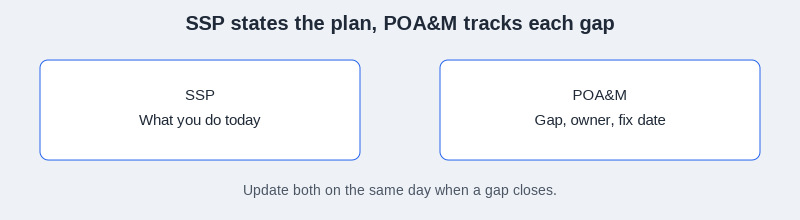
SSP means System Security Plan. POA&M means Plan of Action and Milestones. CMMC means Cybersecurity Maturity Model Certification. The SSP describes your system and how each safeguard is met. The POA&M lists each gap, its owner, and its planned fix date.
What the SSP does
The SSP names your system boundary. It names each safeguard and how you meet it. It names inherited controls, and who provides them. It names the people behind each safeguard, by role.
A strong SSP is honest about gaps. It does not claim a safeguard is met when it is not. It points to the POA&M for each gap. That pointer is what makes the SSP credible.
What the POA&M does
The POA&M holds one entry per gap. Each entry needs five facts. First, the safeguard that is not met. Second, the weakness in plain words. Third, the owner of the fix. Fourth, the planned fix date. Fifth, the current status.
A POA&M is a work list, not a wish list. A gap with no owner will not close. A gap with no date will drift. A gap with no status update looks abandoned, even if work is under way.
How the two link, entry by entry
Link each POA&M entry to its SSP section. Use the same safeguard name in both documents. Use the same wording for the gap in both documents. When a fix closes, update both documents on the same day.
Here is a simple example. The SSP says multifactor authentication is in place for remote access, except for one legacy system. The POA&M entry names that legacy system, its owner, and the date it will move to multifactor authentication. The assessor can follow the thread from plan to gap to fix.
Update the SSP when a gap closes. Do not leave a closed gap in the SSP as still open. Do not leave an open gap out of the POA&M. The two documents must agree, or the assessor will ask which one is true.
Mistakes that break the link
Do not write the SSP as if every safeguard passes. Do not hide gaps in a separate file the assessor never sees. Do not copy one POA&M entry across many safeguards. Each gap needs its own owner and its own date.
Review both documents together each quarter. Check that every SSP gap has a POA&M entry. Check that every POA&M entry still names a live SSP section. Retire entries only when the fix is tested, not when the fix is planned.
Sources
- NIST SP 800-171 Revision 2.
- CMMC Assessment Guide, Level 2.
- Original diagram by PolicyCortex.
Next step
Want evidence tied to each SSP section from live systems? See how PolicyCortex collects it.