Chapter 11
How Do I Write Mobile and Wireless Device Rules Into the SSP?
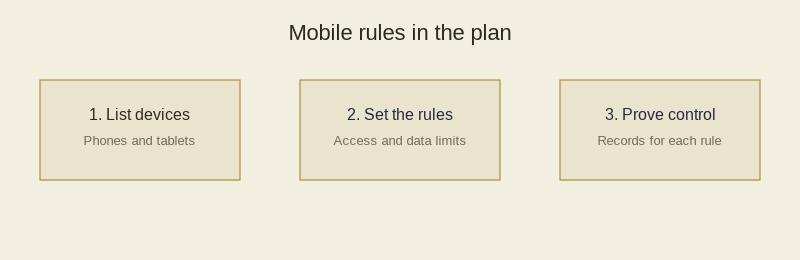
Staff read work mail on phones, but your plan says nothing about those phones. That gap shows up fast in an assessment. The fix is to write mobile rules into the plan where assessors already look.
A System Security Plan (SSP) is the written plan that describes a system and its safeguards. It covers the system boundary, the safeguards in place, and the people behind them. NIST Special Publication 800-171 Revision 2 sets the safeguards the plan must describe. Controlled Unclassified Information (CUI) is sensitive government information that needs protection, but is not classified.
List the devices in the system description
Start in the system description section. List the device types that store or process CUI. Name phones, tablets, and laptops in separate lines. State whether each type is company owned or personal.
State which networks each device type may use. Name office wireless, home wireless, and mobile data as separate cases. A device rule that ignores home wireless misses where most work happens.
If a device type never touches CUI, say so plainly. State what keeps CUI off it, such as no work mail or no file access. An assessor should not have to guess about a device you left out.
Write one rule set per safeguard
Write mobile rules under the safeguards they support, not in one stray appendix. Access rules go with access control. They should state who may connect a device, and how access is removed when staff leave.
Encryption rules go with system protection. They should state that CUI on a device is encrypted. They should state the encryption standard your team uses. Name the tool that enforces it, if one is used.
Loss rules go with incident response. They should state what staff do when a device is lost. They should state who to call, and how fast to report it. They should state how remote wipe works, if you use it.
Wireless rules go with the network sections. They should state which wireless networks are allowed. They should state that public wireless needs a secure tunnel. They should state that unknown networks are not used for CUI work.
Prove each rule with a record
Each rule needs a record an assessor can check. For access, keep the device list and the approval for each device. For encryption, keep a device compliance report with dates. For loss, keep the incident log and the wipe record. For wireless, keep the network settings record.
Review the device list each quarter. Remove devices that staff no longer use. Remove access for staff who left. A stale device list makes every mobile rule look weak, even when the rules are good.
What to do this week
List every device type that can reach CUI. Add one rule set per safeguard section. Attach one dated record per rule. Check that the device list matches the access list.
Sources
- NIST SP 800-171 Revision 2, National Institute of Standards and Technology.
- NIST SP 800-18 Revision 1, Guide for Developing Security Plans, National Institute of Standards and Technology.
- Original diagram by PolicyCortex.
Next step
Want plan sections linked to live evidence? See how PolicyCortex collects it from live systems.