Chapter 14
How Do I Document the Workstations and Laptops That Store or Process CUI?
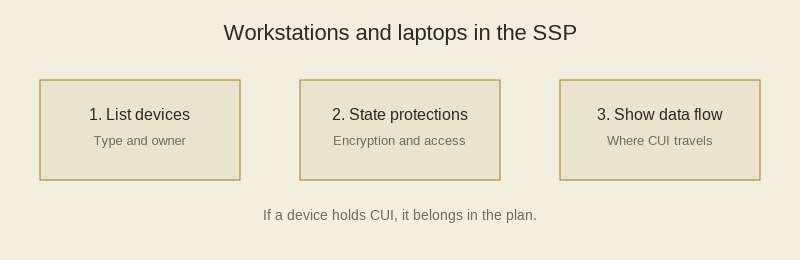
Your plan describes servers in detail, but says little about laptops. Assessors notice that gap fast, since staff do most CUI work on laptops. Closing it takes one clear section, not a rewrite of the whole plan.
A System Security Plan (SSP) describes your system and how you protect it. Controlled Unclassified Information (CUI) is government information that needs protection. Requirement 3.12.4 of NIST Special Publication 800-171 Revision 2 asks for the SSP. The SSP must describe the system boundary, the operating environment, and how each requirement is met.
List the devices, by group
Do not list every laptop by serial number in the main text. Group devices by type and role instead. One group can be staff laptops. Another can be shared workstations. Another can be admin workstations. For each group, state the count, the operating system, and the owner team.
Point to a separate inventory for the device detail. The inventory lists each device, its owner, and its location. The SSP names the inventory and its location. When a device changes, update the inventory first. Then update the SSP count only if the group changes.
State the protections for each group
For each group, state how CUI is protected on the device. State the encryption used for stored data. State the access control that limits who can log in. State the malware protection that runs on the device. State the patch schedule that keeps the device current. State the remote access rule for staff working away from the office.
Tie each protection to the requirement it meets. Encryption ties to requirement 3.13.11. Access control ties to the access control family, 3.1. Remote access ties to requirement 3.1.12. These links let an assessor move from plan to proof without guessing.
Show where CUI travels
Draw a simple data flow for each group. Show where CUI enters the device. Show where it is stored on the device. Show where it leaves the device, such as a shared drive or email. Show what leaves the boundary and what stays inside it.
Name the connections in the SSP section on system interconnections. A laptop that syncs to a cloud drive needs that drive named. A workstation that prints CUI needs the printer named. Unnamed connections are the most common finding in this section.
Handle personal and shared devices
State the rule for personal devices in plain words. If personal devices may not hold CUI, say so directly. If they may, state the controls that apply to them. Shared workstations need a rule too. State who may use them and how sessions are separated. State how CUI is cleared between users.
Keep the section current
Review the device section when staff join or leave. Review it when a new device type arrives. Review it when a tool changes, such as a new encryption product. Date each review and note what changed. A dated review note proves the plan is a living document, not a one time paper.
Sources
- NIST SP 800-171 Revision 2, National Institute of Standards and Technology.
- 32 CFR Part 170, Cybersecurity Maturity Model Certification Program, Code of Federal Regulations.
- Original diagram by PolicyCortex.
Next step
Want your plan linked to live device evidence? See how PolicyCortex collects it from live systems.