Chapter 35
How Do I Describe the Operating Environment in the SSP for Practice 3.12.4?
An assessor who cannot picture your system cannot judge your safeguards. The operating environment section of your System Security Plan fixes that. It shows where the system runs, who uses it, and what it connects to.
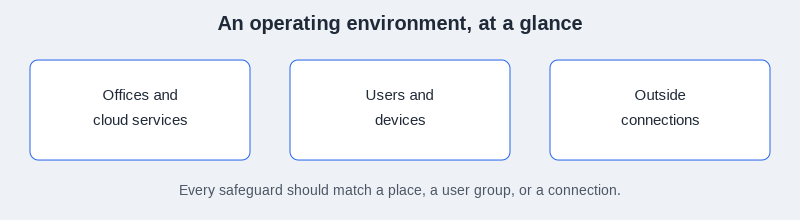
SSP means System Security Plan. NIST SP 800-171 Revision 2 sets requirement 3.12.4. That requirement asks for plans that describe system boundaries, environments of operation, and links to other systems. The plans must also show how each requirement is implemented. CUI means Controlled Unclassified Information.
Start with where the system runs
List every place the system operates. Name each office that hosts parts of it. Name each cloud service it runs on. Name each data center or server room in scope. A vague line like "the cloud" tells the assessor nothing.
For each location, note what lives there. Say which servers, data stores, or services sit in that place. Say whether CUI is stored, processed, or sent from there. If a location holds no CUI, say so plainly.
Then describe who uses it and how
Name the user groups, not just job titles. Say which staff handle CUI each day. Say which contractors or partners touch the system. Say whether anyone reaches it remotely, and from what kind of device.
Remote access changes the environment. A system used only in one office is a small environment. A system reached from homes and hotels is a large one. Describe remote access honestly, even when it widens the boundary.
Then map the connections
List every connection to another system. Name the outside system and its owner. Say what data flows across the link. Say which direction it flows. Say what protects the link, such as encryption or access limits.
Connections often hide the real boundary. A forgotten link to a vendor portal can move CUI outside your scope. A test system linked to production can do the same. Walk the network with your team and list each link you find.
Keep the section short and current
One page of clear facts beats five pages of background. Use a table for locations and connections. Use short lines for user groups and data flows. Update the section when a location opens or closes. Update it when a new connection appears. Update it when remote access rules change.
Check the section against the rest of the SSP. Each safeguard in later sections should match a place, a user group, or a connection named here. A safeguard with no home in this section looks invented. An environment item with no safeguard looks unprotected.
Sources
- NIST SP 800-171 Revision 2.
- NIST SP 800-171A.
- Original diagram by PolicyCortex.
Next step
Want evidence tied to each SSP section from live systems? See how PolicyCortex collects it.