Chapter 40
How Detailed Should Each Control Description Be in the SSP?
Your assessor should not need to call you to understand your plan. If a description needs a phone call, it needs more detail.
SSP means System Security Plan. CMMC means Cybersecurity Maturity Model Certification. CUI means Controlled Unclassified Information. NIST means National Institute of Standards and Technology.
The test for enough detail
Write each description so a stranger can check it. Name the safeguard, the system, and the proof. If one of the three is missing, add it. That is the whole test.
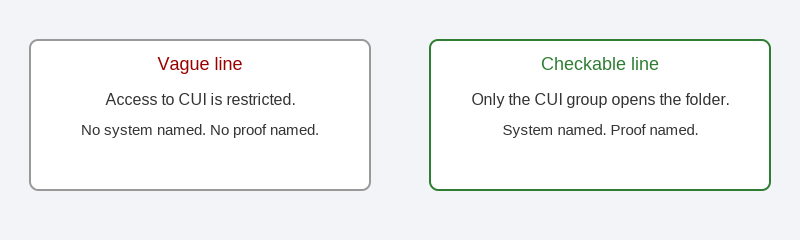
A vague line versus a checkable line
A vague line says access to CUI is restricted. A checkable line says only the CUI group can open the folder. The group is set in the identity system. The dated permission export proves the setting. Reviews run each quarter in this example and are filed.
What each description needs
First, what the safeguard does, in plain words. Second, which system or tool enforces it. Third, who owns it by role, not by nickname. Fourth, which record proves it works. Fifth, how often the proof is refreshed. Skip marketing words and skip history lessons. The assessor wants facts, not a story.
How long should it be
Most descriptions need three to five sentences. Simple safeguards need fewer, complex ones need more. Length is not the goal, checkability is. If you write ten sentences with no proof named, cut it. If you write two sentences with all three facts, keep it.
Keep descriptions true over time
Update a description when the system changes. Date each change in the version history. Old descriptions are the fastest way to lose trust. A plan that matches reality reads as honest.
Sources
- NIST SP 800-18 Revision 1, Guide for Developing Security Plans.
- NIST SP 800-171 Revision 2.
- CMMC Assessment Guide, Level 2.
- Original diagram by PolicyCortex.
Next step
Want SSP sections tied to live evidence? See how PolicyCortex builds them.